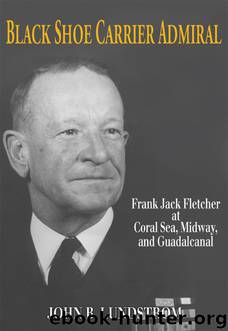
Black Shoe Carrier Admiral by John B. Lundstrom
Author:John B. Lundstrom [Lundstrom John B.]
Language: eng
Format: epub
ISBN: 9781612512204
Publisher: Naval Institute Press
CHAPTER 22
The 27 July Conference
ASSEMBLING THE FORCES
On 18 July Ghormley directed Fletcher to loiter west of Tongatabu until Noyes and Kinkaid appeared, then form the carrier striking force. Later, Turner’s amphibious ships and Crutchley’s cruiser force would join him. For the next week, therefore, Fletcher could do little beyond plan in isolation. On 21 July the Platte transferred her remaining oil to the Cimarron, then left for Nouméa with a destroyer to fetch more fuel from the W. C. Yeager and return in late July. With TF-61 gathering three hundred miles west of Tongatabu, the group with the farthest to go was Turner’s at Wellington. Informed Turner could reach the assembly area on 26 July, Fletcher set the grand rendezvous for that afternoon, after which the combined force would conduct rehearsals in Fiji to the northwest.1
Noyes’s TF-18 with the ailing Wasp and Transdiv Two dropped anchor at Tongatabu on 18 July. The Wasp engineers brilliantly accomplished the brutal work of lifting the rotor and replacing the blading in her starboard high-pressure turbine. On 21 July she attained twenty-five knots. Cincpac certainly dodged a bullet. Even so, the reliability of the Wasp’s power plant over the long term was in question. It might not hold up if light winds compelled long runs more than twenty-five knots to launch fully loaded planes. Noyes recommended she return to Pearl, “At first available opportunity after employment now started.” On 23 July TF-18, less the transports, contacted TF-11. The next day Fletcher transferred the Vincennes to Noyes and detached the destroyer Hull to Suva to fetch important visitors.2
Having left Pearl on 15 July Kinkaid anticipated a routine run to Tongatabu. En route the North Carolina and Portland fueled destroyers “with usual efficiency,” according to an admiring Commander Laing, the RN liaison officer. Prevailing light winds forced Kinkaid to increase speed for flight operations and burn more fuel than he liked. On 23 July he was shocked to learn that local time at Tongatabu was Z-12, although the Tonga Islands were east of the 180th meridian. The date line snaked eastward to include them. Thus TF-16 was a day late. “We kept very quiet about it,” Kinkaid later wrote, and doubted “Nimitz or Fletcher know it to this day.” On 25 July he found Tongatabu’s harbor filled with auxiliaries and began refueling his depleted ships from the Kanawha, Mobilube, Whitney, and the store ship Aldebaran. The North Carolina only fueled to 60 percent. To make the scheduled rendezvous, TF-16 cleared the anchorage before sunset due to the difficulty of getting large ships through the harbor channel in darkness. Kinkaid gratefully sighted the other forces on 26 July, released the auxiliaries to Turner’s TF-62, and took position eight miles to starboard of TF-11. He later blamed the fog at Tongatabu for his delay but recalled, “Fletcher looked at me skeptically and said: ‘We don’t have fog in the tropics.’”3
After a long flight from Pearl detouring around storms, Turner belatedly reported to Ghormley at Auckland on 15 July.
Download
This site does not store any files on its server. We only index and link to content provided by other sites. Please contact the content providers to delete copyright contents if any and email us, we'll remove relevant links or contents immediately.
Waking Up in Heaven: A True Story of Brokenness, Heaven, and Life Again by McVea Crystal & Tresniowski Alex(37813)
Empire of the Sikhs by Patwant Singh(23089)
We're Going to Need More Wine by Gabrielle Union(19051)
Hans Sturm: A Soldier's Odyssey on the Eastern Front by Gordon Williamson(18594)
Leonardo da Vinci by Walter Isaacson(13339)
The Radium Girls by Kate Moore(12033)
Tools of Titans by Timothy Ferriss(8402)
Educated by Tara Westover(8056)
How to Be a Bawse: A Guide to Conquering Life by Lilly Singh(7490)
Permanent Record by Edward Snowden(5850)
The Last Black Unicorn by Tiffany Haddish(5640)
The Rise and Fall of Senator Joe McCarthy by James Cross Giblin(5282)
Promise Me, Dad by Joe Biden(5155)
The Wind in My Hair by Masih Alinejad(5100)
A Higher Loyalty: Truth, Lies, and Leadership by James Comey(4965)
The Crown by Robert Lacey(4818)
The Iron Duke by The Iron Duke(4365)
Joan of Arc by Mary Gordon(4116)
Stalin by Stephen Kotkin(3971)
